

This post is a longer-form version of my op-ed in the Calgary Herald today, with links and receipts.
Any negotiator worth their salt is a humble one. None of us has all the right answers, and different circumstances require different approaches. But as someone who has practiced and studied intergovernmental relations in Canada for over two decades, I find the separatists’ latest ad campaign mystifying.
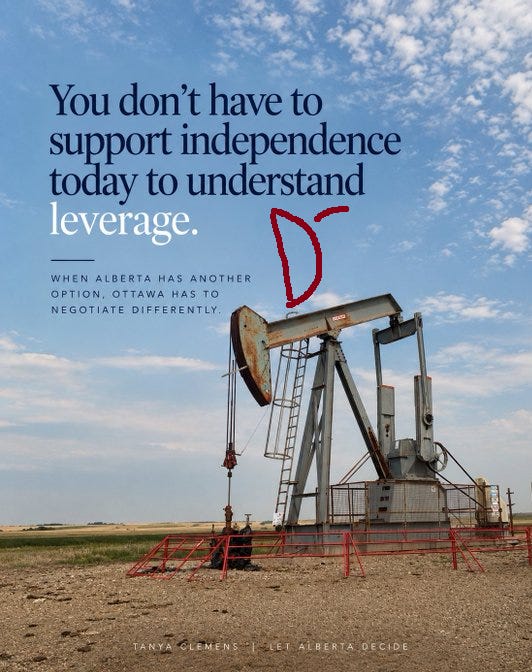
“You don’t necessarily have to want leave Canada,” they tell us. “You can vote for Option 2 (to hold a second referendum) simply to give Alberta more leverage in its dealings with Ottawa.”
The message has some merit in theory. The knife-to-the-throat approach can be effective as a last resort. But it depends on a credible threat, which is undermined by the separatists’ own messaging.
Plainly put: you don’t build leverage by announcing to the world that your threat is empty.
A gambit this big only creates leverage if the other side believes you are prepared and able to follow through on the alternative. The moment you tell the rest of Canada that support for Option 2 isn’t a true metric for independence support, you have killed the credibility of the threat. That’s precisely what the separatists are doing by telling Albertans to vote for Option 2 even if they oppose independence.
Imagine sending a ransom note that says: “Give us what we want. But just so you know, most of us have no intention of actually harming the hostage.”
You don’t have to be a master negotiator to sense the folly in the separatists’ strategy. Anyone who’s played cards knows that a bluff only works because the other players think you’ve got the goods. You don’t push all your chips into the middle of the table while whispering, “Don’t worry, I’ve got nothing.” Wink, wink.
Yet, that’s the latest move from a separatist movement struggling to find support in the final weeks of the campaign.
A Failed Strategy
Sadly, we’ve seen this move fail before. Jason Kenney made the same argument when convening Alberta’s 2021 equalization referendum. He admitted the vote would never really lead to constitutional change, but that it was only intended to generate “leverage” with Ottawa — bargaining power he could use to force the rest of the country to make other changes to the federation.
The problem? Everyone knew the strategy. Ottawa heard Kenney confirm it as an empty threat, and so did other provincial governments. If turnout is any indication, Albertans saw through it, too. Only 39 percent cast a ballot, meaning that, in the end, only 1 in 4 eligible voters backed Kenney’s ill-fated bid for bargaining power. If anything, the episode set back Alberta’s credibility on the intergovernmental stage.
That experience should have been a warning, particularly for a group whose raison d’etre seems to do the opposite of what Jason Kenney does.
The lesson — you cannot manufacture leverage by revealing a bluff before you make it — seems lost on separatist leaders.
The Real Quebec Playbook
More broadly, you don’t accomplish much in intergovernmental relations by making demands and threatening to leave if you don’t get everything you want. That’s one of the recurring weaknesses of the separatist approach, which relies on the Trumpian assumption that negotiations consist of simply presenting the other side with an ultimatum and waiting for capitulation. Some art. No deal.
Alberta separatists often cite Quebec as a role model, pointing to the province’s success in extracting concessions from Ottawa and the rest of Canada. The thing is: most of Quebec’s gains have come through conventional, consensus-building intergovernmental relations after the threats of secession had subsided and the provincial government put down the knife.
Consider Robert Bourassa’s famous five demands, which formed the basis of the Meech Lake and Charlottetown Accords. The constitutional packages ultimately failed, but much of what Bourassa sought was subsequently achieved in practice without reopening the constitution (see table below).
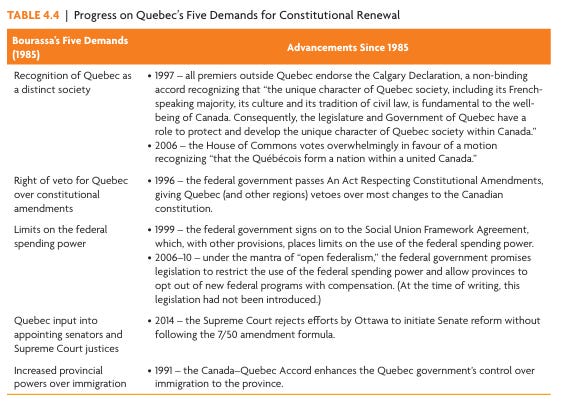
Quebec made many of these durable gains only by turning demands into workable agreements, cultivating relationships across Canada, and building support that crossed regional and party lines. Separatists might not have the patience, stomach, or skill for it. But it is that painstaking work of coalition- and consensus-building that delivers what constitutional brinksmanship can’t.
More to the point of this post, though: you never once saw a serious Quebec separatist begging for federalists to lend them their votes for “leverage” against Ottawa.
In fact, those sorts of hollow threats make the constructive work harder. Governments facing an ultimatum have their own constituencies. Premiers and prime ministers cannot simply surrender to threats without creating incentives for every other government to adopt the same tactic. (Again, recall Meech and Charlottetown.) Threatening your negotiating partners can harden positions that might otherwise be malleable.
A Better Way
There are plenty of things Alberta should be pushing for to improve the federation. I’ve written about many of them, and mine is by no means an exhaustive list.

Separatists will tell us that we’ve tried this approach before. True. And it has yielded gains for Alberta. More than once. And we can do it again.
In the meantime, we should stop pretending that threatening to leave — while publicly explaining that we don’t really mean it — is some sophisticated negotiating strategy. We have tried manufacturing leverage through a referendum once already. Nobody took it seriously, and many view separatism through the same lens.
Polls show (and separatists concede with their own “leverage” strategy) a simple fact: a vast majority of Albertans want a better deal within Canada. Let’s stop bluffing and issuing hollow ultimatums, and start the much harder work of building one.
"Your money or your life", accompanied by a weapon, is a threat that has to be taken seriously. "Your money or my life", not so much.
Well stated. The changes that Danielle Smith wants to see in the Constitution can be negotiated both with Ottawa and by 'working with like minded Provinces' to seek concensus on those changes. Other than the purely racist, xenophobic questions SHE put on the referendum, those relating to Constitutional issues seem to be actions the Province, any Province, can undertake. I do think the separatist position is ridiculous and will lose the vote; but, Smith is already gearing up for a binding referendum next spring," we will have to work quickly " she quipped when discussing this before. The real problem is the MAGA ideology the UCP and some other Conservative leaders have adopted. Even the separatists seem to believe that ultimatums are negotiations. The Conservatives at all levels seem afraid to actually do the work of governing and want to rule by fiat.