

This presentation was given to the Downtown Edmonton Community League (DECL) on September 27, 2026. It is not intended as an endorsement of any one side of any referendum question.
This fall, Albertans are being asked to answer ten referendum questions.
I am not a passive bystander in this process. I have made my views clear on how we got here and what’s at stake.
In this post, I want to take a step back and provide Albertans with a sense of where we are, how we got here, and where we are headed.
Where are we?
The ten questions fall into three broad groups. Voting yes or no to the first nine carries different implications.
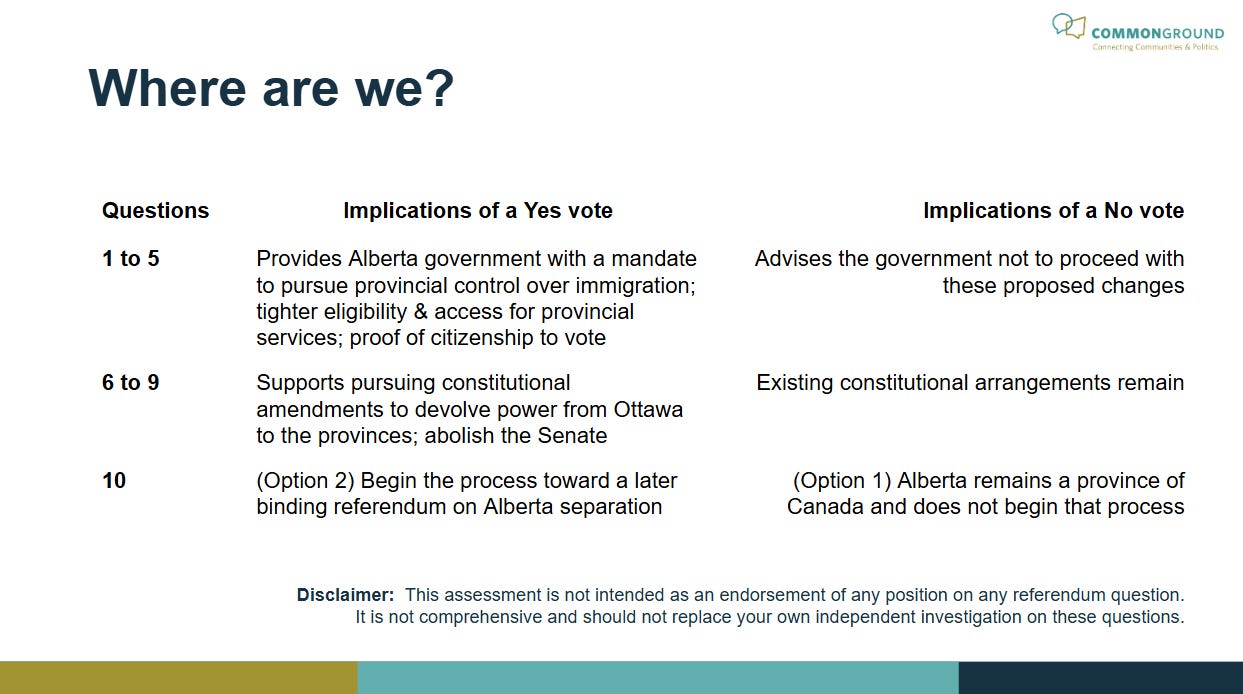
Questions 1 to 5 concern the treatment of immigrants in Alberta. Taken together, a Yes vote would give the Alberta government a political mandate to pursue greater provincial control over immigration, restrict eligibility for some provincially funded services, impose residency requirements or fees on some non-permanent residents, and require proof of citizenship to vote provincially. A No vote would advise the government not to proceed with those proposed changes.
Questions 6 to 9 concern the Constitution. They deal with provincial selection of federally appointed judges, abolition of the Senate, provincial opt-outs from federal programs, and giving provincial laws priority in certain areas of overlapping jurisdiction. A Yes vote would support pursuing these changes by engaging with governments across Canada to amend the Constitution (a process that would require unanimous consent); a No vote would leave the existing arrangements in place.
Question 10 concerns separation. Option 2 directs the provincial government to begin the legal process required to hold a later, binding referendum on independence. Option 1 keeps Alberta in Canada without beginning that process.
There are arguments on both sides of each set of questions. I cannot possibly capture all of the cases made for yes/no, remain/commence in this post. Third-party advertisers are making those arguments. Here is a very brief synopsis of what many of them have been saying.
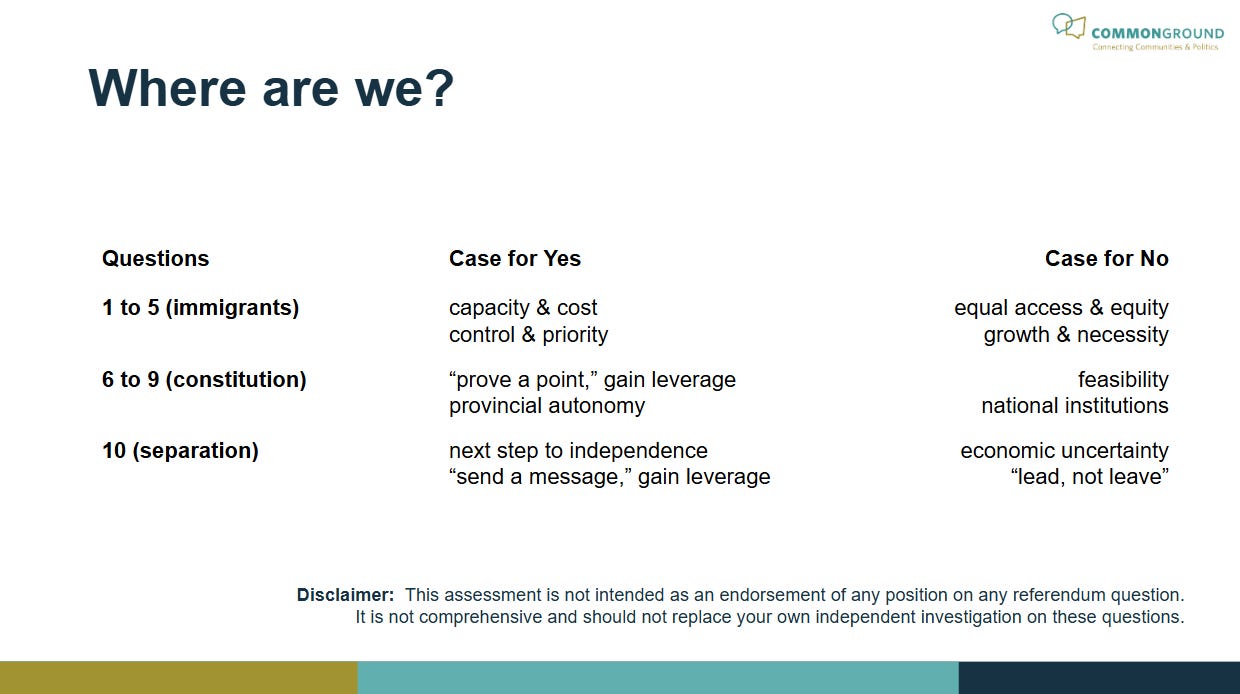
Supporters of the proposals to change our treatment of immigrants emphasize the capacity of our government programs and services to keep up with the demands of a growing population, provincial control over the immigration system, and prioritizing permanent residents over newcomers. Opponents emphasize equal access, equity of treatment, the importance of newcomer workers to economic growth and staffing public services, and Alberta’s love and need for newcomers.
On the constitutional questions, supporters talk about provincial autonomy and using the votes to gain bargaining leverage to improve Alberta’s place in Confederation; opponents question the feasibility of the proposed changes and defend the role of national institutions.
On separation, supporters see Option 2 either as a step toward independence or a way to strengthen Alberta’s hand within Confederation. Opponents of separation (Option 1 supporters) emphasize economic uncertainty and argue that Alberta should lead, not leave Canada.
Again, these are very high-level observations that may help you make sense of the various arguments. You are wise to learn more from campaigns on all sides of these questions. Here is an official list of those organizations.
How did we get here?
We are holding this referendum because the Government of Alberta decided to do so.
Referendums are not new to Alberta. The province has used direct votes on prohibition, rural electrification, daylight saving time and, most recently, equalization.
But referendums do more than settle policy questions. Governments can also use them strategically: to manage internal factions, reframe political disagreements, bypass opposition, reset the political agenda or strengthen their bargaining position with other governments. Those possibilities are particularly important when we consider a ballot containing several questions that reach beyond what Alberta can change unilaterally.
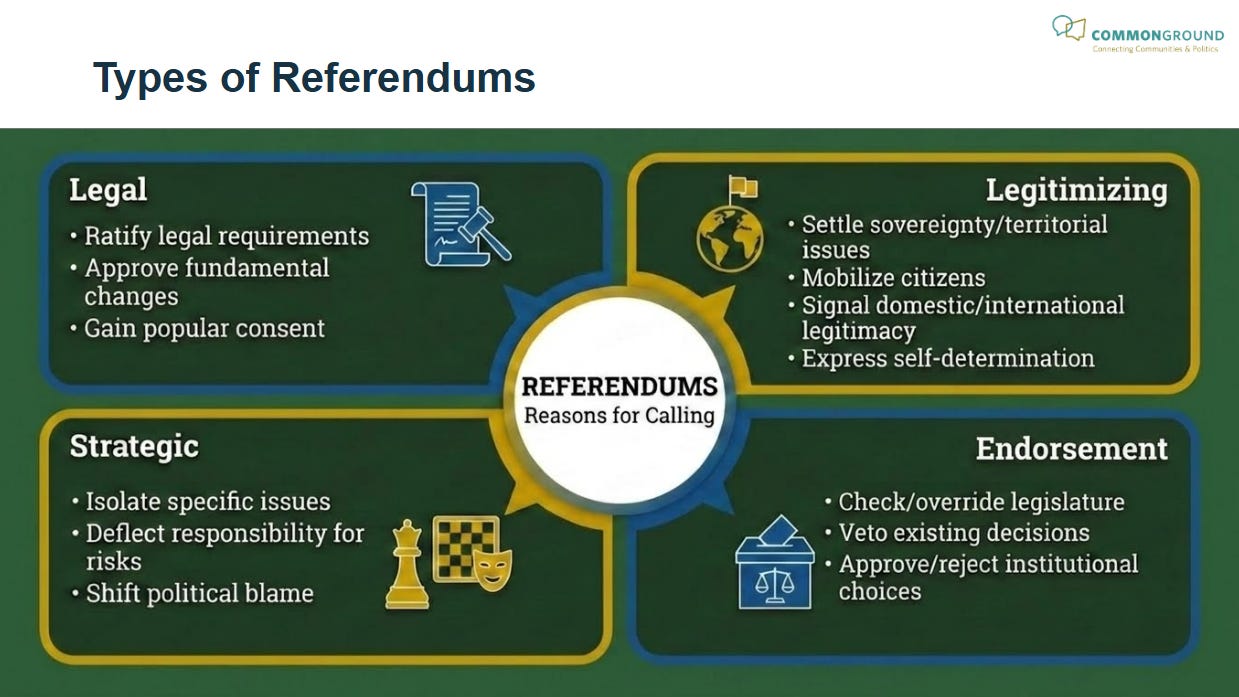
That means voters should think about more than the literal wording on each ballot. They should also ask: What mandate would each result create? What would happen next? And who would gain the power to interpret what my vote meant?
Where are we headed?
This referendum is unfolding at a time of deep political polarization in Alberta and the broader world. Increasingly, political opponents are treated not as adversaries to be defeated today and negotiated with tomorrow, but as enemies whose defeat justifies changing the rules of the game.
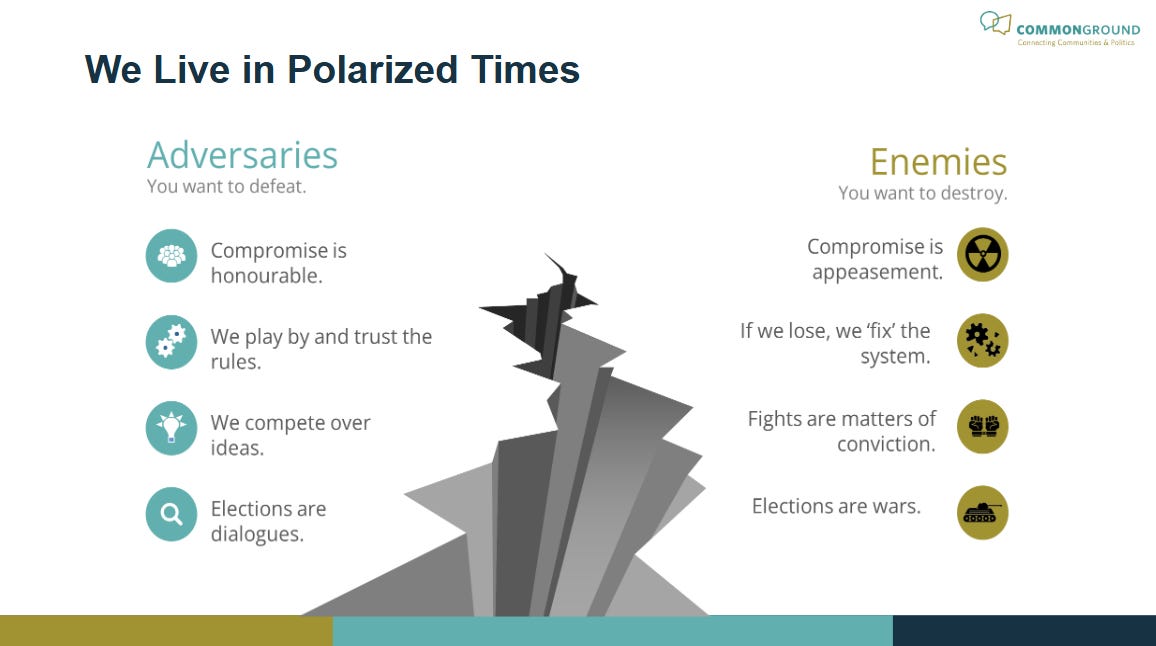
That distinction reflects two very different visions of democracy.
A pluralist approach starts from the assumption that society contains many legitimate groups with competing interests. The common good is something we construct through debate, negotiation, compromise, and institutions that disperse power.
A populist approach tends to imagine a singular “people” confronting corrupt elites. Politics becomes more majoritarian, more zero-sum, and more focused on winning control so that the public interest can be enacted directly.
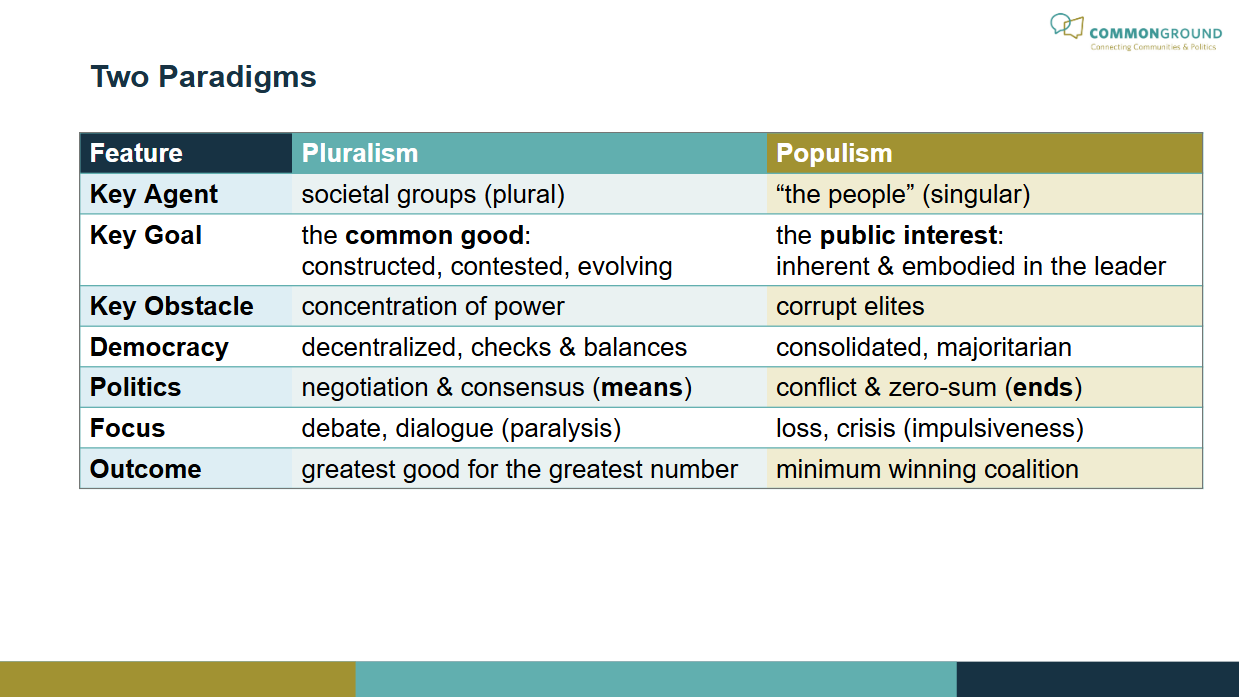
As I’ve written elsewhere, voting “no to the nine” and to remain in Canada is in keeping with pluralist values. Voting “yes” to questions 1 to 9 and to continue the process toward separation fits squarely with the populist worldview.
Most Albertans find themselves caught in the middle. The vast majority see themselves as both Canadian and Albertan, for example. They want to improve Alberta’s relationship with the Canada and see value in pursuing both more autonomy and building bridges with the rest of the country. And polls suggest they value the contributions of newcomers while demanding changes to the immigration system. Binary referendum questions do not allow them to weigh in with nuance.
Regardless of the outcome of these referendums, Albertans from all sides will need to find a way to come back together. That’s something my teams at Common Ground, the Peter Lougheed School of Politics and Democracy, and Lead Not Leave are working on.
Prepare to vote
Whatever your views on these questions, ten ballots are too important to confront for the first time in the voting booth.
Read the questions beforehand. Understand what a Yes or No vote actually does — and what it does not do. Make a voting plan. Talk with people who disagree with you. And challenge complacency and apathy. I give more tips on this in my recent piece:

Referendums reduce complicated choices to simple marks on a ballot. Our responsibility as citizens is to make sure our thinking is not equally simple.
As others have pointed out, the first 5 of these questions promote negative attitudes if not outright hatred against identifiable groups. Worse, the rationales for them do not stand up to analysis. For example, claiming that immigrants only contribute $1 in taxes for every $10 spent in health care and education for them, is both a lie, and a lie by misrepresentation. Firstly, the real figure is $1.00 in $6.67, not $10.00. Secondly, that figure applies to all Albertans, because income taxes do not pay for our entire budget. Oil royalties and business taxes, as well as other smaller revenue sources, plus some borrowing most years, makes up the rest. Thirdly, most immigrants are working and are paying taxes, so charging only that group another $1,900 is double taxation. Do that to a Conservative leaning identifiable group and watch the screaming erupt at the injustice.
Questions 6 to 9 basically ask for an endorsement of a path to religious fascism. Who actually believes that judges appointed by this government or its UCP successors would be fair and impartial? Not me. Nor, I suspect, any of the other 770,000 who voted NDP in the last election. Getting rid of the Senate? Clearly an attempt to remove any possible obstacles to Christian fascist rule. And based on a blatant lie that it never does anything, when in fact historically it has rarely but significantly intervened to prevent the excesses of the madding of crowds, exactly as the Fathers of Confederation intended. In fact, the UCP anti-trans legislation is an example of precisely what the Senate was put in place to put a stop to, were it to be done at the Federal level.
The question asking for "no strings attached" federal money is a just plain ripoff of the rest of Canada and Albertans; it is fundamentally corrupt at the heart of it. Otherwise, the Meech Lake qualification of this provision would have been part of the referendum question. That qualification states that the Province must put a functionally equivalent program in place to get the money. In other words, if you wanted to put a program in place that did the same thing as the Federal one but in your own way, then you'd still get the money. Alberta wants to take the cash to subsidize lower taxes that they can brag relentlessly about, and deliver a substandard value proposition to its citizens.
Mr. Wesley does an admirable job of trying to objectively define the opposing sides in this referendum debate. However, the populists have defined themselves as an elitist class uniquely qualified to pass vindictively hateful judgements on everyone else in society who dares to disagree with them. It is reasonable to suggest that a majority of Albertans will reject their pretentious claims to superiority over everyone else.
The problem is all these questions are so loaded that there’s no room for exploration of the middle ground approach
You’re either for or against what the question is asking