
ID? Please.
Alberta separatists confront the downsides of draconian voter validation rules

For months, many of us have warned about Alberta’s new voter ID rules.
In theory, requiring government-issued photo ID to participate in democracy sounds reasonable. In practice, voter ID laws:
borrow directly from the Trump playbook,
prevent more eligible voters than fraudsters from participating,
disproportionately affect the most marginalized groups in our politics,
reduce the number of options for voters to prove their identity,
rely on an inflated sense of how many people actually have the necessary ID, and
overestimate the electoral advantage it confers on right-wing citizens.
As I’ve written before, the UCP’s voter ID laws are a solution in search of a problem. There is little evidence of widespread election fraud in Alberta, but there is clear evidence that stricter ID requirements can prevent eligible citizens from voting — especially those without stable housing, students, seniors, and people in Indigenous and racialized communities.
This also includes rural Albertans, whose government ID is less likely to meet the highest standards (including a residential address).
Which brings us to the challenges facing the Alberta separatist movement.
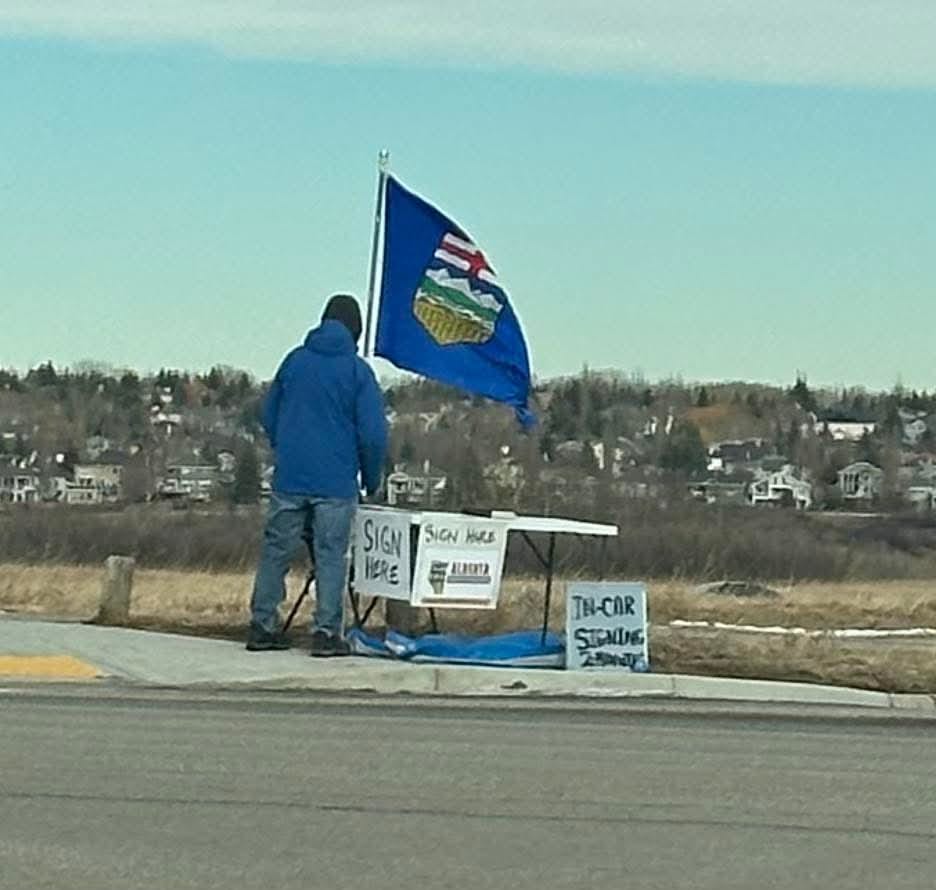
A lot of rural folks are experiencing the downsides of restrictive voter ID rules first-hand, with many being denied access to the separatism petition. Organizers behind high-profile citizen initiatives — including those pushing for a referendum on Alberta’s future — are encountering the very real procedural and democratic barriers that come with tighter verification rules.
No doubt: these petitions, which require 170,000+ validated signatures to trigger a referendum, should have some sort of signee validation. But they nonetheless depend on an open process. And, deeply flawed and misguided as they are, the values behind “direct democracy” insist that everyone has equal access.
The UCP’s reforms have worked in the opposite direction, restricting Albertans’ ability to participate in petitions, recalls, referendums, and elections by ruling out vouching and other tried-and-true means of proving one’s eligibility to vote.
And the UCP is proposing to go further, adding a question to this fall’s mega-referendum that would, if passed and carried into law, require all Albertans to dig up citizenship documents in order to exercise their fundamental democratic rights.
If you think it’s hard to sign your name to a petition today, wait until you try to vote in the next provincial election.
Ironically, those who appear the most bullish about these voter ID measures (and the other “racist and useless” ones on this fall’s ballot) are also among the least likely to have the proper documentation to participate in those votes.
This, in at least in small part, is why separatists are having difficulty harvesting signatures in rural Alberta. And why right-wing parties in other parts of the world are having second thoughts about bringing in new laws that prevent their supporters from voting.
It turns out efforts by governments to choose their voters don’t always work out as planned.
Readers will know my position on the separatist referendum. I don’t think it’s wise to hold it, and I will cast a “no” ballot if I’m required and allowed to. (I’m fortunate to have a valid piece of ID.) For these reasons, I’m not saddened to hear rumours that the separatists won’t reach their signature target. And anyhow: if they don’t meet their goal, it will not be because of voter ID.
But you also won’t find me talking about leopards-eating-faces. Because there’s something deeper at stake.
Democracy is as much about process as it is about outcomes. The same rules that make it harder for one marginalized voter to cast a ballot can also make it harder for any citizen to meet the thresholds required to be heard. Whether you support separation or not, the principle is the same: a healthy democracy lowers barriers to participation; it doesn’t raise them.
Alberta has long prided itself on a democratic culture that encourages participation from all walks of life. That tradition is worth defending. This fall, Albertans will have a chance to tell the government how they feel about the new voter ID rules by voting “no” to further erosion of ballot access.
As much as the government and its supporters want the October referendum questions to focus on whether you distrust your fellow Albertans, the true question at stake is whether you trust a system that makes it harder for them to participate in the first place.
The UCP has chosen its position. Albertans will need to decide if they agree.
Thank you Jared. I think you've summarized the problem well.
So true about the draconian ID rules! I was not able to sign the Anti-Coal one because as a rural Albertan my driver's license lists my PO Box and not a physical address. All of my bills list my PO Box too and because I use a different name than my legal name none of those bills would have worked anyhow. So, if you changed your name when you married, your spouse gets the bills in their name, or you use a different name on bills than your legal name then you have no suitable ID for voter verification. I find it satisfying, though, that the loudest people spouting the conspiracy about huge voter fraud from non-citizens voting are the very people disenfranchised by their laws and rules. They also had property tax increases because of the cost of hand counting when their conspiracy-riddled brains decided vote tabulators were part of some plot. Hoisted on their own conspiracy-driven petards.