

Turns out losing a referendum is easier than you think. Just don’t turn out.
Taking a massive lead in public opinion and transforming it into a narrow win or loss is pretty simple. Just ask Hillary Clinton’s followers or our anti-Brexit friends in the UK.

Here’s the recipe:
Start with the assumption that polls are accurate and will hold.
Mix in a hunch that somebody else will volunteer and donate.
Drop in a dash of complacency and a splash of apathy.
Get back on your couch and wait for October 20.
This fall’s referendums in Alberta will be decided by turnout. There are vanishingly few undecided voters when it comes to the lead question on separation. This leaves both sides with nothing to do but pull the vote. As Robson Fletcher shows with his online simulator, lower turnout for one side or the other will decide the outcome.
And this referendum is different from routine electoral events.
Standalone referendums are rare in Canada. They’re normally held alongside an election, where parties and candidates have incentives to get people to vote. This time, there’s no election to anchor it or focus attention.
That leaves it up to the rest of us to mobilize.
Skip the Line, Not the Vote

Turnout will matter in Alberta’s October referendums. In terms of campaigning, get-out-the-vote (GOTV) efforts may matter more than persuasion, given that the vast majority of Albertans have made up their minds (at least on the separation question).
So, over the next month, here are five (5) things everyday Albertans can do to boost turnout.
Make your own voting plan now. Ideally, order your mail-in ballots before the September 25 deadline. Barring that, commit to voting in advanced polls. Both of these options are safe and secure, and they free up space in what promise to be record-setting lines on October 19.
Stop mistaking slacktivism for action. Posting, liking, and reposting social media content may feel like you’re contributing to democracy. None of those actions puts a single ballot in the box. Close the apps and use your phone to call up folks and urge them to make a plan to vote. Better yet, get face to face with friends, family, and colleagues (see #5).
Sign up to work the referendum. Instead of worrying or complaining about how long the lines are going to be, do something about it. Register to work with Elections Alberta and tell your friends and family to, too. If we don’t have enough workers, the chances of folks showing up and walking away on October 19 are much higher. Note that you cannot both work for Elections Alberta and volunteer for a third-party advertiser (see #4).
Donate and volunteer. Various third-party advertisers are in dire need of support to marshal their get-out-the-vote campaigns. We don’t need any new organizations, and you don’t need to do this alone. Even $20 or a few hours of your time can make a real difference.
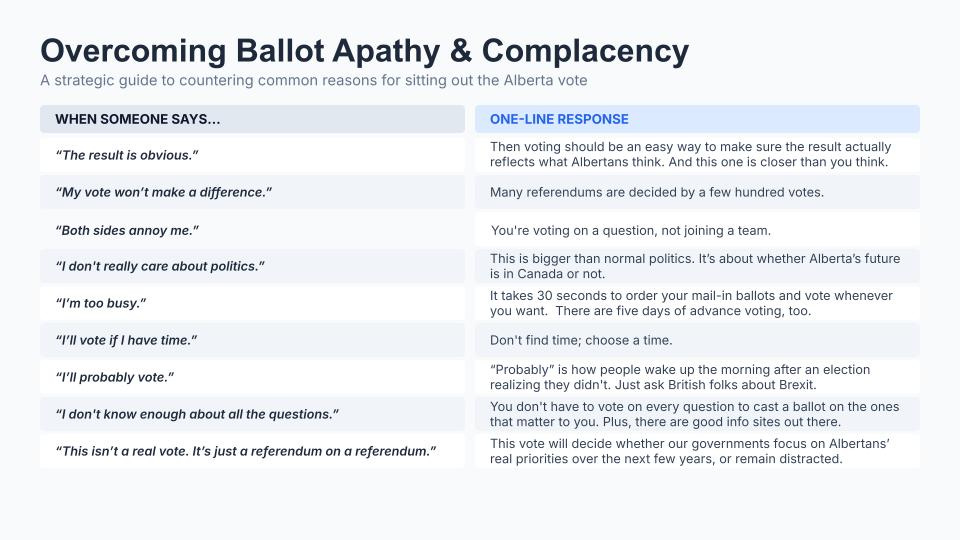
Push back on apathy & complacency. The most dangerous sentence you’ll hear from Albertans this month? “I’m sure it will all be fine.” Referendums aren’t decided by the number of people who are “sure”. They’re decided by the number of people who show up. Here’s a great video that explains the math and why you should be “votemaxxing” on these questions. And here’s a list of common excuses and some responses you can use to counter them:
The Alberta separatists are acting as if they are a political party but they are not. They hold rallies and political forums and conferences. They supply lawn signs and post signs on the sides of thoroughfares (often illegally). A political party in a democracy (1) agrees on a platform of promises and identifies strategies for achieving them, electing its candidates to run the party banner (2) provides a free vote on the priorities in (1) and accepts that vote. This is what happens with separatist parties in Quebec but not Alberta. There is no (1) here and (2) is only satisfied by a referendum, not a vote for a party's policies or past achievements as in (1). The reason this distinction is important is because democracy is not served by separatist rhetoric which sounds like politicial promises but their claims carry no responsibility or accountability in an election or referendum.
Well, as long as our mail-in ballots actually make it to the elections office, actually get counted, and none are rejected for quality or positioning of our Xes, we've already shown up and already voted. It was disappointing to discover that we could not deliver them our ballots in person and place them in a ballot box at the elections office. Instead we were directed to drop them in the Canada Post mailbox outside the office. And maybe that's part of the problem: those of us who've already mailed our ballots feel that we have done our part and it's all over.